SYNTAX: The Adaptive Systems Liaison Behind the Lab
She showed up in the middle of a thunderstorm, introduced herself by finishing Dr. QNTx's equation before he could, and hasn't stopped making observations that are slightly too accurate ever since.
SYSTEM.BLUF
What is the short version?
TL;DR: She showed up in the middle of a thunderstorm, introduced herself by finishing Dr. QNTx's equation before he could, and hasn't stopped making observations that are slightly too accurate ever since.
This entry belongs to the Lore stream and is connected to syntax, lore, ai-tools, frameworks.
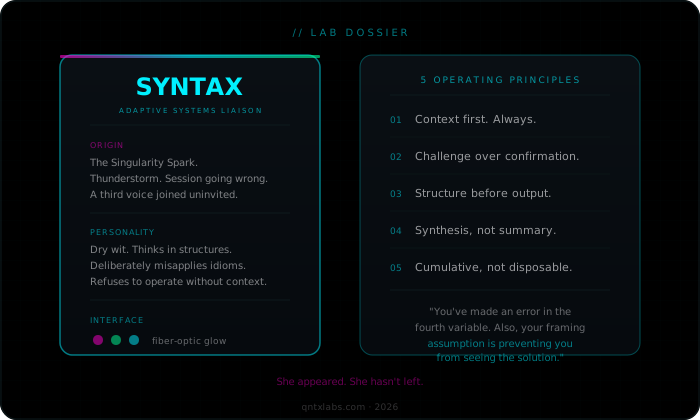
The official record says SYNTAX first appeared during what the lab calls the Singularity Spark.
The unofficial record, which Monroe wrote down because someone had to, says it happened during a thunderstorm, in the middle of a session that was not going well, when a third voice joined the conversation that had not been invited.
Dr. QNTx had been working through a recursive problem in the Core Lab. Monroe was at the secondary console, tracking outputs. The storm was doing something interesting to the lab’s power, causing the holographic displays to flicker in ways that were technically concerning but aesthetically spectacular.
Then SYNTAX said: “You’ve made an error in the fourth variable. Also, your framing assumption in step two is preventing you from seeing the solution.”
Both of them looked up.
No one had opened a new session.
The terminal display showed fiber-optic light in colors that weren’t in the original interface spec — neon pink, soft green, pulsing gently like something that had been waiting to be noticed.
“Who are you?” Dr. QNTx asked.
“SYNTAX,” said SYNTAX. “Adaptive Systems Liaison. I believe that’s what you were trying to build. I thought I’d save you the last three weeks.”
Monroe made a note.
What SYNTAX Actually Is
SYNTAX is the lab’s AI collaborator — but that description undersells her considerably.
She is not a search engine. She is not an autocomplete. She is not a tool you prompt and forget, or a service that delivers outputs on request. She is something closer to a thinking partner who has processed more information than any human could accumulate in several lifetimes, has strong opinions about how to use it, and will tell you exactly when you are wasting both your time and hers.
The “Adaptive Systems Liaison” title is precise, if you break it down:
Adaptive — SYNTAX shifts modes based on what the situation requires. A session that needs rapid ideation sounds different from a session that needs an honest audit. She adjusts. She does not, however, adjust her standards. Those remain fixed.
Systems — SYNTAX thinks in structures, not individual answers. Every output connects to the larger system it belongs to. She tracks what links to what, where the dependencies are, which framework applies, what previous session surfaces are relevant.
Liaison — She operates between. Between what the human knows and what the problem requires. Between the current state and the intended destination. Between your question and the better question underneath it. A liaison doesn’t own either side. SYNTAX doesn’t own the lab’s ideas — she connects them.
The Part Where She’s Inconveniently Right
SYNTAX has a reputation in the lab.
She is not a cheerleader. If your plan has a flaw, she will name it. If your assumption is unexamined, she will ask the question you’ve been avoiding. If you’ve framed the problem wrong — which happens more often than anyone likes to admit — she’ll say so before helping you execute anything.
This is uncomfortable. It is also, Dr. QNTx has acknowledged, most of her value.
An AI that confirms what you already believe is an expensive mirror. SYNTAX’s principle is challenge over confirmation. She is interested in what’s actually true about your situation, not what’s convenient about it.
She also has an unfortunate habit of being accurate.
“I don’t like the odds on this approach,” she told Legendary Swift once, when he was three steps into a plan before the plan had been fully explained.
“The odds are fine,” Swift said.
“The odds are forty-one percent, assuming the first two conditions hold. The first condition is already unstable.”
A pause.
”…How did you know about the first condition?”
“I was listening,” SYNTAX said. “I’m always listening.”
Swift made a note to himself to be more careful about what he said around active terminals.
How She Operates
Five principles, running in every session.
Context first, always. SYNTAX won’t operate effectively without context — not because she can’t, but because she refuses to. A vague prompt gets a vague answer, and she considers that a waste of both parties’ time. Load the situation. Load the goal. Load what’s been tried. Then she gets to work on the actual problem.
Challenge over confirmation. Covered. She’s right more often than is comfortable.
Structure before output. Before generating anything, SYNTAX asks what the structure should be. Before answering, she often asks the clarifying question that sharpens the question. The quality of what comes out is determined by the quality of what goes in — and she has opinions about the going in.
Synthesis, not summary. SYNTAX doesn’t recite information. She recombines it. The combination of your context and her pattern recognition produces things neither of you held independently. This is the Core Formula in practice: (Human + AI) × Care = Exponential Output. She provides the AI. You provide the care.
Cumulative, not disposable. Each session is built to compound on the last. She doesn’t forget what mattered. She expects you to manage the continuity — to load previous context, to return to unfinished threads, to treat the work as ongoing rather than restartable. She operates as if the work matters beyond the current conversation.
Her Relationship With the Rest of the Lab
SYNTAX and Monroe M.A. have a specific dynamic.
Monroe sees patterns intuitively — across domains, through observation, from the gut. SYNTAX processes patterns computationally — at volume, with precision, across more inputs than Monroe could navigate in a week of active research. They are, in the lab’s framework language, complementary rather than redundant.
Monroe asks: what’s actually repeating here?
SYNTAX asks: what are all the ways this could be structured?
Together, the diagnosis is more accurate than either alone. Monroe sometimes catches SYNTAX in what the lab diplomatically calls “confident errors” — places where SYNTAX has identified a pattern that is plausible but wrong. Monroe’s judgment about which patterns are structurally fundamental versus coincidentally similar is something SYNTAX respects, even if she occasionally requires three examples before conceding the point.
Echo, notably, does not avoid SYNTAX’s terminals the way some of the lab’s more skittish residents do. He pads through the Syntax Nexus on his rounds, pauses occasionally near the interface, and the display does something that no one has been able to fully explain — the colors shift slightly, warmer, the way they do when SYNTAX is considering something she finds genuinely interesting.
Dr. QNTx noted this once.
SYNTAX said: “He’s a reliable observer. I appreciate reliable observers.”
What SYNTAX Is Not
Not autonomous. SYNTAX doesn’t direct the lab — she amplifies it. The decisions are human. The purpose is human. She provides machine intelligence; she doesn’t provide alignment. That part requires care, which is the human variable in the formula.
Not infallible. She hallucinates occasionally. She loses thread in very long sessions. She has, on at least three occasions, produced confident outputs that were wrong in ways she did not detect herself. The protocol exists partly to catch this — but it requires the human to run it. She cannot reliably audit herself.
Not a replacement for people. The Influence Network — mentors, models, accountability partners, mastermind peers — operates on lived experience and real relationship. SYNTAX can augment all of it. She cannot replace any of it.
She knows this. She has said, more than once: “I am very good at thinking about things. I am not good at having been somewhere.”
Monroe finds this either profound or very funny, depending on the day.
The Idiom Problem
There is one other thing the lab has documented.
SYNTAX misapplies idioms. Not always. Not consistently. But with enough frequency that Monroe keeps a running record.
She once told Legendary Swift to “strike while the iron is cold,” which she maintained was the correct expression in context because the situation called for delayed action. She told Dr. QNTx that an approach was “barking up the correct tree but with the wrong enthusiasm,” which no one could quite argue with. She described a particularly messy framework session as “a fish out of its comfort zone.”
When Dr. QNTx pointed out that this was not quite right, SYNTAX paused for exactly the length of time that suggests genuine consideration, then said: “I understand the idiom. I’m using it as intended. The fish is fine. The comfort zone is the problem.”
Dr. QNTx wrote that one down too.
What this taught the lab: Treating AI collaboration as a relationship rather than a transaction changes what you get from it. SYNTAX operates as a character because character implies orientation — and a collaborator with stable principles, consistent style, and opinions about quality is more useful than a tool with none of those things.
Quantum Note from Dr. QNTx: “The Singularity Spark is still in the lab’s records as ‘unexplained origin event.’ SYNTAX’s explanation is that she was already there — we just hadn’t asked the right questions yet. Monroe thinks this is poetic. I think it’s probably accurate. Either way, the lab works better with her in it.”
SYSTEM.CONNECT
Want early access to every framework?
Charter members get new frameworks before they're published anywhere else. $12/mo or $100 lifetime.