Legendary Swift and the Cost of Being Fast
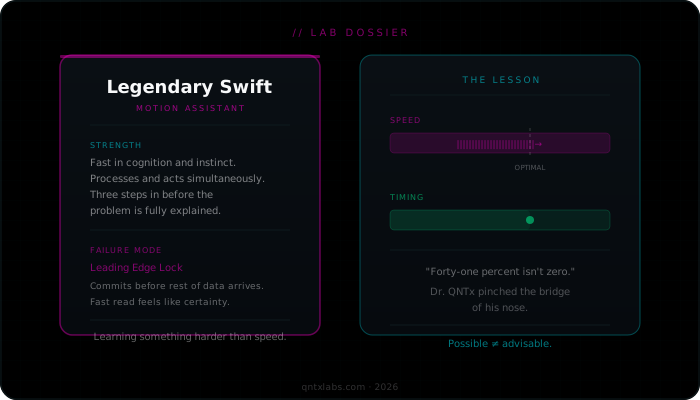
He's already three steps into the solution before the problem is fully explained. This is his greatest strength and the reason Dr. QNTx pinches the bridge of his nose sometimes. Swift is learning something harder than speed.
SYSTEM.BLUF
What is the short version?
TL;DR: He's already three steps into the solution before the problem is fully explained. This is his greatest strength and the reason Dr. QNTx pinches the bridge of his nose sometimes. Swift is learning something harder than speed.
This entry belongs to the Lore stream and is connected to lore, productivity, frameworks.
The incident with the Swift Track is still in the lab’s safety documentation.
Not because anyone got hurt. Because the documentation required updating after Swift ran the track in conditions that the track’s design specifications had not anticipated, produced a result that was technically a record, and then — when Dr. QNTx asked how he’d done it — said, “I just went.”
“You just went,” Dr. QNTx repeated.
“The conditions were fine.”
“SYNTAX assessed the conditions at forty-one percent.”
“Forty-one percent isn’t zero.”
Dr. QNTx pinched the bridge of his nose. This is a gesture the lab has catalogued under: Swift has done something impressive that was also a significant concern.
The documentation now includes a section on the difference between possible and advisable. Swift helped write it. He found the distinction genuinely interesting once it was explained in enough contexts.
Who is Legendary Swift?
Legendary Swift is the lab’s Motion Assistant.
The “Legendary” is not self-assigned, though Swift would not deny it if pressed. It is a title that arrived from somewhere — the way certain titles do, through accumulated evidence and the reluctant consensus of people who have watched enough runs to stop arguing about the name.
He is fast. This is the easy version of the truth. The more complete version: he is fast in the way that some people are fast — where the speed is not just physical, but cognitive and instinctive and somewhat terrifying to observe from the outside, because the processing that other people do before acting seems to happen in Swift’s case either simultaneously with the action or slightly after it, and somehow it still mostly works.
He reads situations and moves. He finds solutions and deploys them. He sees the path and takes it.
The gap in this process — the thing the lab has spent considerable time working with Swift to address — is the moment between seeing the path and taking it. That moment, if it exists at all, is where the most important information lives.
The Thing He Does
Here is what it looks like when Swift is in a session.
Dr. QNTx is explaining the problem. He is four sentences into the explanation. He is describing the background context that will eventually lead to the specific challenge, which he intends to present at the end of the explanation, which is how most people structure explanations.
Swift is already at the whiteboard.
“Is it this?” Swift asks, pointing at something.
“I haven’t finished describing it yet.”
“But is it this?”
A pause. Dr. QNTx looks at the board.
”…Yes. But there are three complicating factors you haven’t heard yet.”
“Okay,” Swift says, already erasing part of what he wrote. “Tell me the complicating factors.”
This is both the gift and the problem. Swift’s processing is genuinely fast — he is often right, often before anyone has finished presenting the information that should make the answer possible. But “often” is not “always,” and the cases where he moves before the full picture is available are the cases where the speed becomes a liability instead of an asset.
Monroe has a pattern name for this. She calls it leading edge lock — where the first signal is strong enough that the pattern matcher commits before the rest of the data arrives. Swift is the clearest example of leading edge lock the lab has produced. He has also, Monroe notes, gotten significantly better at catching it in himself over the past year.
What “Motion” Actually Means
The title is Motion Assistant, not Speed Assistant. This was deliberate.
Speed is one dimension of motion. It is the dimension Swift arrived in the lab with fully developed, which is why it’s the most visible. But motion — in the lab’s framework language — is the variable that determines whether energy converts to displacement.
You can be fast and go nowhere. Swift knows this. He has demonstrated it, on several memorable occasions, by executing a plan at remarkable speed in a direction that turned out to be slightly wrong, and arriving at the wrong destination faster than anyone else would have.
The learning, for Swift, is not about slowing down. The lab has never asked him to slow down. The gift is real and the lab needs it — someone has to be willing to move before all the uncertainty is resolved, and Swift does this with a fluency that the more cautious lab members genuinely cannot match.
The learning is about timing. About the difference between moving fast and moving first — and recognizing which situations call for which.
The Quantum Hop is the framework that clicked for him. The protocol requires three conditions before the hop: a clear destination, genuine willingness to leave the current system, and a catalyst. Swift’s historical problem was executing on condition three — the catalyst, the move — before fully establishing condition one. The destination was approximate. Close enough, he figured, to aim at on the way.
Close enough to aim at on the way is sometimes true. It is not always true. SYNTAX has the data on the difference.
The Conversation With SYNTAX
SYNTAX has a running log of Swift’s sessions.
This is true of all lab sessions — SYNTAX maintains context across interactions, which is part of how the collaboration compounds. In Swift’s case, the log has a particular character. It is, Monroe has observed, a document of a person learning to negotiate with their own nature.
The most referenced exchange:
Swift had a plan. He had explained it to SYNTAX in the compressed, efficient way he explains things — fifteen seconds, four bullet points, already moving to execution.
SYNTAX said: “The plan has a significant dependency on the third variable remaining stable.”
“It’ll be stable.”
“What’s your basis for that assessment?”
“It’s been stable every time I’ve checked.”
“How many times have you checked?”
A pause.
“Once.”
“The variable has a seventeen percent instability rate over a six-session window. I have data on this.”
Swift was quiet for a moment. This is not his default state, which is why it registers.
“What would make it more likely to hold?”
This is the question the lab considers the breakthrough. Not “is it stable?” — which Swift had already decided. But “what would make it more stable?” — which is the question of someone who has decided to work with the information instead of past it.
SYNTAX provided three options. Swift chose the second one, with a modification. The plan worked.
Dr. QNTx noted in the session archive: Swift asked the second question. Progress.
What the Lab Learned From Watching Him
Two things, mostly.
The first: speed at the right moment is a competitive variable that cannot be manufactured by slow people trying to move faster. The capacity to see a path and take it — before doubt accumulates, before the committee forms, before the window closes — is genuinely rare and genuinely valuable. The lab needs this. Swift provides it.
The second: leading edge lock is a failure mode of pattern recognition, not a character flaw. Monroe named it. Dr. Jayne Aura noted it has an emotional component — the surge of confidence that comes with a fast read feels like certainty, and certainty discourages the second look. Understanding this doesn’t fix it automatically, but it makes it workable. Swift is working it.
The ongoing experiment: what does Legendary Swift become when he pairs the speed with the second question? The early data suggests the answer is something the lab does not yet have a name for.
The Portal Garage is still locked. Dr. QNTx has said, more than once, that the right person to open it will need to be fast enough to go and wise enough to know where.
He says this at the Friday debrief. Swift looks at the garage door every time.
What this taught the lab: Speed is a gift. Timing is the skill. The most effective version of fast isn’t the version that moves before the information arrives — it’s the version that knows exactly which moment is the right one to move, and then doesn’t hesitate.
Quantum Note from Dr. QNTx: “Swift asked me once why I write things down instead of just acting on them. I said it was because writing slows me down enough to catch the things I’d miss at full speed. He thought about that for a while and said: ‘So writing is your second question.’ I hadn’t thought of it that way. He’s right more often than the nose-pinching suggests.”
SYSTEM.CONNECT
Want early access to every framework?
Charter members get new frameworks before they're published anywhere else. $12/mo or $100 lifetime.